


Our CoMOOC pathway for teachers is made by teachers and education professionals working on the ground in challenging environments
What is a CoMOOC?
Co-designed Massive Open Collaborations (CoMOOCs) are a new approach to providing teacher professional development at scale. Unlike conventional MOOCs (Massive Open Online Courses), CoMOOCs are designed together with teachers and education professionals working in similar contexts and aim to respond to their most pressing educational challenges. CoMOOCs create opportunities for sharing learning and practice and building communities of educational practitioners working in diverse settings. They are hubs of both intellectual and practical innovation, which harness the extensive knowledge and experience of those working in the field, transforming the courses into rich shared resources accessed through an open online learning platform or adapted for face-to-face or hybrid modalities.
CoMOOC Enrollment Data
_edited.jpg)
Overview of our Teacher Professional Development Pathway
Teachers on the Thai border often work in crowded classrooms with students who speak different languages and who have experienced displacement, conflict, and hardship. Although they remain deeply committed to their students, the lack of meaningful and contextualized support is leading many teachers to leave, creating a serious human resource crisis that affects education quality. In response, the Inclusive Education Foundation, in collaboration with 11 education organizations and University College London (UCL), is working to address these challenges by co-developing an innovative teacher professional development pathway. The project directly engages local education partners to co-design three accredited courses, developed as both in-person training and delivered through FutureLearn and other online platforms. Each course includes modules that respond to the needs of educators on the border, such as teaching in low-resource settings, inclusive strategies for children with disabilities, and multilingual pedagogy. Courses are available in Burmese, S’Gaw Karen, and English. Together, these three CoMOOC courses form an inclusive pathway that enables teachers to meet the entry requirements for the Professional Graduate Certificate of Education (PGCE) in Teacher Development in collaboration with the University of London (UoL).
CoMOOCs using Beekee

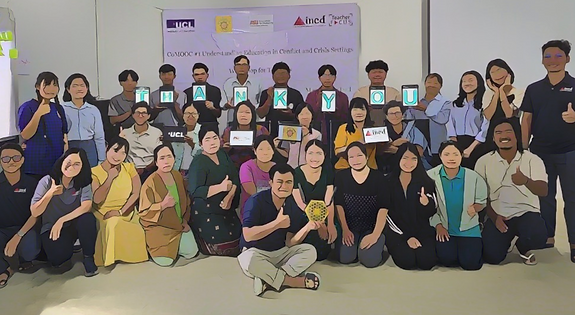
InEd and UCL have established a new partnership with Arizona State University (ASU) to deliver our CoMOOCs in Burmese using an offline, hybrid modality using their BeeKee Box technology. The BeeKee Hub emits a local signal that allows devices to connect directly to its Moodle platform and access the course content without internet. The system is designed for areas with limited or no internet and unstable electricity. ASU has uploaded CoMOOC 1 on their Moodle platform, where it is available in both English and Burmese. The model supported self-directed learning, allowing teachers to take the course at their own pace while developing digital literacy and other 21st-century skills. Facilitators also organized and led discussions on key theories to deepen understanding and connect concepts to classroom practice.
Lists of the key topics in CoMOOC 1
Understand how you can improve learning environments
-
You’ll start by exploring and responding to the challenges of being an educator in conflict settings.
-
Then, you’ll learn to imagine and create change with limited resources and assess whether technology can enhance the learning environment.
Learn to promote access to education in conflict settings
-
Next, you’ll delve deeper into understanding education within conflict and displacement contexts.
-
You’ll gain insights into different educational theories and how to apply them in practice to connect school life to the broader society.
-
Furthermore, you’ll learn to gather your learners’ perspectives, understand their hopes and dreams, and create a safe and supporting learning environment. Reflecting on these experiences will be crucial for developing actionable strategies.
Gain a deeper understanding of emotional and social learning (SEL)
-
Finally, you’ll understand essential SEL concepts and how to support learners’ emotional wellbeing and development through various educational strategies, including counselling.
-
You’ll move from principles to actions by designing and implementing supportive learning activities. At the end of the course, you’ll reflect on your learning and consider how to further develop effective educational strategies.


Explore the full CoMOOC 1 experience
Explore the full CoMOOC 1 experience

_edited_edited.jpg)

